Scalp massages stimulate the blood circulation and this in turn channels more nutrients to the hair roots. The increased circulation ensures the best starting conditions for every individual hair. Besides, a stimulating scalp massage has many general benefits for our wellbeing. Here we share with you how to give yourself a nice hair massage for hair growth.
Is a too-short haircut making you wish your hair would grow faster? We’ve all been there. Of course your hair will eventually grow out, but is there a way to increase your hair growth speed and make hair grow faster? Keep reading to find out.
Determining Hair Growth Speed
At most, hair grows one-half inch per month. That’s only six inches per year – max!
Everyone’s hair grows at different rates. The hair at which your speed grows during the anagen phase of the hair growth cycle is determined by a number of factors, including genetics, age, hair type and overall health. Unfortunately, science has yet to uncover a way to speed up hair growth.
Can You Make Hair Grow Faster?
Sadly, there’s no way to actually make hair grow faster. However, you can help make your hair grow stronger and healthier looking by following these tips:
Eat plenty of protein
You are what you eat. Hair is made of protein, so it makes sense that you should eat plenty of it to grow stronger hair. Add lean proteins to your diet like chicken, fish and tofu.
Take a supplement
Vitamins and minerals like biotin, zinc, and iron are also critical to healthy hair growth. Eat a balanced diet, or take a hair health supplement to make sure your bases are covered.
Massage your scalp
Massaging the scalp stimulates blood flow to the hair follicles, supporting hair growth by delivering hair-healthy nutrients.
Prevent Breakage
Preventing breakage is key to making the most of your hair growth. Avoid heat tools, don’t bleach your hair, and be extremely careful when detangling especially when hair is wet. Visit your hairdresser for ⅛-inch trims every 8-10 weeks to remove split ends and ensure that your hair looks healthy and vibrant.
How to Make Hair Look Instantly Thicker
Luckily, there are a few easy styling tips that can make hair look thicker while you wait for it to grow:
- Style with a hair thickening serum. Using a thickening serum boosts up individual strands, making hair look more voluminous and healthier. If you’re looking for some extra oomph for your ‘do, look no further.
- Blow dry hair upside down. This simple styling trick costs nothing, but has big results. When blowdrying your hair, flip your head upside down and blast the roots. Drying the roots in this position will create loads of bouncy volume and make hair look thicker.
- Use hair extensions. Hair extensions can make hair look thicker and longer — at a price. Longer-lasting extensions require professional installation and can be quite expensive. Clip-ins are more affordable, but must be removed each night. And watch out: hair extensions can pull out and damage hair, so use a weight appropriate for your hair type. If you’re not careful, your hair could look even shorter and more damaged after you remove them, tempting you to re-install them even sooner to cover the damage, and the vicious circle continues!
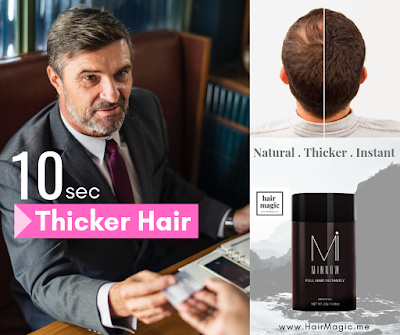
- Try Hair Magic Hair Building Fibers. Hair Magic Hair Building Fibers are the best way to create the appearance of thicker hair immediately. Spray or sprinkle Fibers into sparse areas, then pat and finish with Hair Magic FiberHolding Spray . Your hair will look instantly thicker, and no one will know! Plus, Hair Building Fibers do not damage existing hair, so you don’t need to worry about harming your hair growth progress.
![]() |
| Visit Online Store |
Can You Make Hair Grow Faster?

Why is my hair falling out?
It's true that men are more likely to lose their hair than women, mostly due to male pattern baldness (more on that later).
But thinning hair and hair loss are also common in women, and no less demoralizing. Reasons can range from the simple and temporary—a vitamin deficiency—to the more complex, like an underlying health condition.
In many cases, there are ways to treat both male and female hair loss. It all depends on the cause. Here are some common and not-so-common reasons why you might be seeing less hair on your head.
But thinning hair and hair loss are also common in women, and no less demoralizing. Reasons can range from the simple and temporary—a vitamin deficiency—to the more complex, like an underlying health condition.
In many cases, there are ways to treat both male and female hair loss. It all depends on the cause. Here are some common and not-so-common reasons why you might be seeing less hair on your head.

1. Physical stress
Any kind of physical traumasurgery, a car accident, or a severe illness, even the flucan cause temporary hair loss. This can trigger a type of hair loss called telogen effluvium. Hair has a programmed life cycle: a growth phase, rest phase and shedding phase. “When you have a really stressful event, it can shock the hair cycle, (pushing) more hair into the shedding phase,” explains Marc Glashofer, MD, a dermatologist in New York City. Hair loss often becomes noticeable three-to-six months after the trauma.
What to do: The good news is that hair will start growing back as your body recovers.

2. Too much vitamin A
Overdoing vitamin A-containing supplements or medications can trigger hair loss, according to the American Academy of Dermatology. The Daily Value for vitamin A is 5,000 International Units (IU) per day for adults and kids over age 4; supplements can contain 2,500 to 10,000 IU.
What to do: This is a reversible cause of hair loss and once the excess vitamin A is halted, hair should grow normally.

3. Lack of protein
If you don't get enough protein in your diet, your body may ration protein by shutting down hair growth, according to the American Academy of Dermatology. This can happen about two to three months after a drop in protein intake, they say.
What to do: There are many great sources of protein, including fish, meat, and eggs. If you don't eat meat or animal products, here are the 14 Best Vegan and Vegetarian Protein Sources.

4. Male pattern baldness
About two out of three men experience hair loss by age 60, and most of the time it's due to male pattern baldness. This type of hair loss, caused by a combo of genes and male sex hormones, usually follows a classic pattern in which the hair recedes at the temples, leaving an M-shaped hairline.
What to do: If you are using medicine to stop hair loss, it may take years to regrow natural hair. Do not wait for the result, you should start enjoying thicker hair. There are hair building fibers that can make hair thicker and fuller instantly (Learn More).

5. Heredity
Female-pattern hair loss, called androgenic or androgenetic alopecia, is basically the female version of male pattern baldness. “If you come from a family where women started to have hair loss at a certain age, then you might be more prone to it,” says Dr. Glashofer. Unlike men, women don't tend to have a receding hairline, instead their part may widen and they may have noticeable thinning of hair.
What to do: If you are using medicine to stop hair loss, it may take years to regrow natural hair. Do not wait for the result, you should start enjoying thicker hair. There are hair building fibers that can make hair thicker and fuller instantly (Learn More).

6. Emotional stress
Emotional stress is less likely to cause hair loss than physical stress, but it can happen, for instance, in the case of divorce, after the death of a loved one, or while caring for an aging parent. More often, though, emotional stress won't actually precipitate the hair loss. It will exacerbate a problem that's already there, says Dr. Glashofer.
What to do: As with hair loss due to physical stress, this shedding will eventually abate. While it's not known if reducing stress can help your hair, it can't hurt either. Take steps to combat stress and anxiety, like getting more exercise, trying talk therapy, or getting more support if you need it.

7. Anemia
Almost one in 10 women aged 20 through 49 suffers from anemia due to an iron deficiency (the most common type of anemia), which is an easily fixable cause of hair loss. You doctor will have to do a blood test to determine for sure if you have this type of anemia.
What to do: A simple iron supplement should correct the problem. In addition to hair loss, other symptoms of anemia include fatigue, headache, dizziness, pale skin, and cold hands and feet.

8. Hypothyroidism
Hypothyroidism is the medical term for having an underactive thyroid gland. This little gland located in your neck produces hormones that are critical to metabolism as well as growth and development and, when it’s not pumping out enough hormones, can contribute to hair loss. Your doctor can do tests to determine the real cause.
What to do: Synthetic thyroid medication will take care of the problem. Once your thyroid levels return to normal, so should your hair.

9. Vitamin B deficiency
Although relatively uncommon in the U.S., low levels of vitamin B are another correctible cause of hair loss.
What to do: Like anemia, simple supplementation should help the problem. So can dietary changes. Find natural vitamin B in fish, meat, starchy vegetables, and non-citrus fruits. As always, eating a balanced diet plentiful in fruits and vegetables as well as lean protein and “good” fats such as avocado and nuts will be good for your hair and your overall health.

10. Autoimmune-related hair loss
This is also called alopecia areata and basically is a result of an overactive immune system. “The body gets confused,” says Dr. Glashofer. “The immune system sees the hair as foreign and targets it by mistake.”
What to do: Steroid injections are the first line of treatment for alopecia areata, which appears as hair loss in round patches on the head. However, it may take years to regrow natural hair. Do not wait for the result, you should start enjoying thicker hair. There are hair building fibers that can make hair thicker and fuller instantly (Learn More).
10 Reasons Why You're Losing Your Hair
1. Heredity is the most common cause of hair loss. It is known medically as “androgenetic alopecia.”
2. Hereditary baldness is not caused by the hair falling out, but rather by normal hair gradually being replaced by finer, thinner hairs.
3. You must lose over 50 percent of your scalp hairs before it is apparent to anyone.
4. More than 50 percent of men have male pattern hair loss by the age of 50.
5. Forty percent of women will have female pattern hair loss by the time they reach menopause.
6. Statistically, hereditary pattern baldness is more commonly inherited from the mother’s side of the family, but hair loss can actually be inherited from the father’s side, the mother’s side, or both.
7. Many think that hair loss can be caused by wearing hats, frequent shampooing, clogged pores, or decreased blood flow to the scalp. These are all myths. Wearing hats: Many believe that frequent hat wearing causes hair loss because it “suffocates” the scalp. Hair follicles actually get oxygen from the bloodstream rather than the air, so wearing hats has no effect on hair loss. Frequent shampooing: When people notice that their hair is thinning, they often pay more attention to the hair that falls out after shampooing and assume that this is the cause. It is completely normal to lose up to 150 hairs per day, many of which are lost when you wash your hair. Clogged pores: If baldness were due to clogged pores, the solution would be to simply clear the pores so the hair could grow. This is not the case. Decreased blood flow to the scalp: Decreased blood flow is actually a result of hair loss, not a cause. Growing hair requires a significant amount of blood flow, but once the hair is lost, not as much blood is needed in the scalp.
8. Certain drugs can cause hair loss. Many of them are used to treat: Cancer Arthritis Depression Heart problems High blood pressure
9. Thyroid imbalance and iron deficiency are reversible causes for hair loss.
9 Surprising facts About Hair Loss
Seeing more strands in your brush than usual? You're not alone. An estimated 80 million Americans experience male- or female-pattern baldness as they age, and countless others suffer hair loss from conditions like autoimmune disorders, diabetes, vitamin deficiencies, stress, and lack of sleep.
While contending with bald spots and thinning tresses is stressful, there is hope: Research shows that it's possible to thicken hair back up through dietary changes.
Fill your plate with the following foods, which are rich in proven hair-growth nutrients, as described in the new book Eat for Extraordinary Health & Healing.
Salmon
Hair is a protein fiber (as are nails), which means you need to eat proteinto grow new strands and keep the existing ones strong. Protein is also required to produce keratin, a key structural component of hair.
A smart choice is marine-based protein, like salmon, which has been shown to boost hair health in women thanks to its omega-3 fatty acids and vitamin content.
Honey
When used as a topical treatment, honey can improve the look of thinning hair. In a study of patients experiencing seborrheic dermatitis, which includes scaling, itching, and hair loss, those who applied a solution of 90% honey and 10% water to their scalp every other day for 4 weeks reported an improvement in hair loss at the end of the study.
Nuts and Seeds
Some of the most promising research on reversing female-pattern hair loss was released in January 2015 in the Journal of Cosmetic Dermatology. Subjects in the study received a nutritional supplement containing omega-3 and omega-6 essential fatty acids and antioxidants for 6 months. The results were overwhelmingly positive: After 6 months, 90% of the subjects reported a reduction in hair loss, 86% reported an improvement in hair growth, and 87% reported thicker hair.
To achieve similar results, eat nuts and seeds high in omega-3s and omega-6s, like walnuts, flaxseed, and oils such as grapeseed, sunflower, and sesame.
Spinach
One study found that women with hair loss have significantly lower iron and vitamin D2 levels than age-matched controls. Spinach is a good bet because it's rich in iron and high in vitamin C, which aids in iron absorption. Toss a spinach salad with hardboiled eggs or mushrooms, both of which are loaded with vitamin D, to give yourself the best shot at slowing hair loss.
Oysters
Zinc seems to be a super nutrient when it comes to preventing and treating hair loss. In one study, researchers compared the zinc levels of 50 people with hair loss due to alopecia areata to 50 healthy controls and found that all of the alopecia patients had significantly lower zinc levels. Another study examined the zinc and copper levels in 312 men and women experiencing hair loss. No matter the cause of the hair loss, all subjects had significantly lower zinc levels than controls.
Fortunately, zinc supplementation and eating plenty of zinc-rich foods can slow hair loss in the majority of these cases, so it's a good idea to add it to your diet. According to the National Institutes of Health, oysters contain more zinc per serving than any other food. Other food sources of zinc include walnuts, spinach, eggs, sunflower seeds, green peas, wheat germ, oatmeal and chickpeas.
Oils
Pumpkin, rosemary, and coconut oilsall act as nectar to the scalp. In one study, researchers gave men with hair loss 400 mg per day of pumpkin seed oil or a placebo for 24 weeks. Those who took the pumpkin seed oil experienced a 40% increase in hair growth.
And there's something to be said for oils even when you don't eat them: When used as a pre-wash and post-wash grooming product, coconut oil has been shown to protect hair against protein loss, and rosemary oil has been shown to increase hair growth comparable to minoxidil, the main ingredient in Rogaine—and with less scalp itching.
A recent study found that a supplement containing cistanche tubulosa (a desert plant used in traditional Chinese medicine) and laminaria japonica (an edible brown seaweed) promoted hair growth in people with mild to moderate hair loss. After 16 weeks of supplementation, volunteers saw a 13% increase in hair volume and a 27% increase in hair thickness. The supplement was also effective at treating scalp inflammation and dandruff.
Seaweed
A recent study found that a supplement containing cistanche tubulosa (a desert plant used in traditional Chinese medicine) and laminaria japonica (an edible brown seaweed) promoted hair growth in people with mild to moderate hair loss. After 16 weeks of supplementation, volunteers saw a 13% increase in hair volume and a 27% increase in hair thickness. The supplement was also effective at treating scalp inflammation and dandruff.
![]() |
| Visit Online Store |
7 Foods That Stop Hair Loss
Recent Posts
Featured Post
How Can I Have Thick Hair in 10 seconds?
What is Hair Building Fiber? Hair loss problem is very distressing to all men. It can lead to low self esteem, low confidence and a...
Powered by Blogger.